Upcoming Projects — Bangalore Property Listing Platform
Next.js listing platform for pre-launch and under-construction Bangalore developments — unit-level inventory with per-configuration pricing and availability, and budget filtering that reasons across configurations rather than projects.
About this project
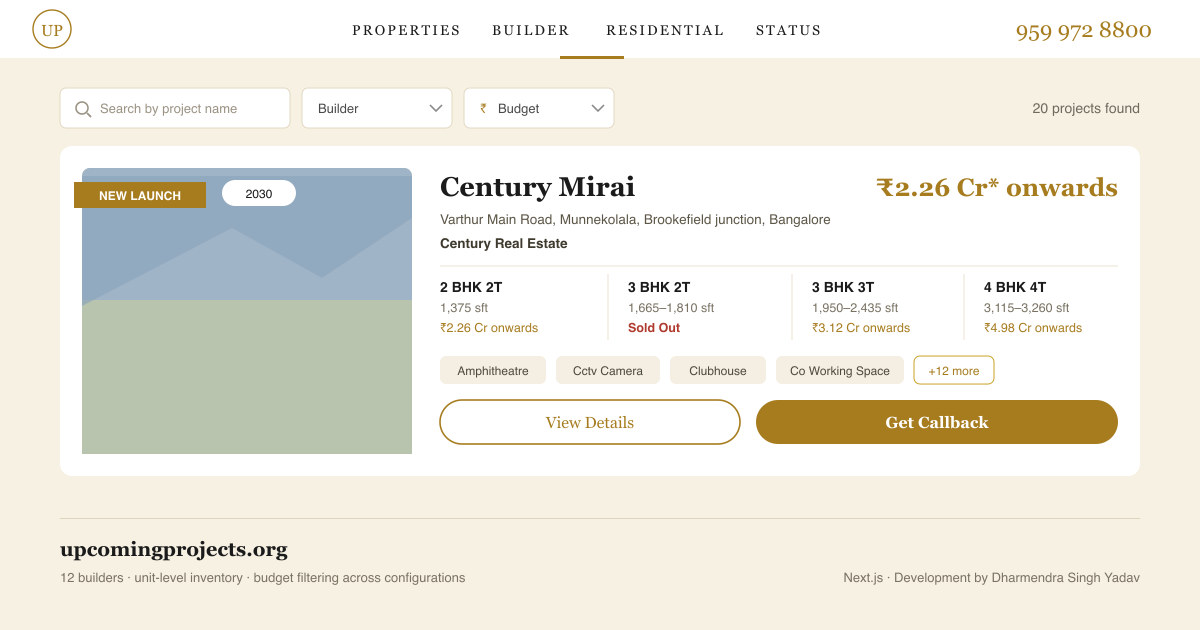
Upcoming Projects is a Bangalore-wide listing platform for residential developments that have not been completed yet — new launches, pre-launches and under-construction projects across twelve developers. I worked on the website as a full-stack developer. It is the third portal I built on this platform, and the one with the deepest data model. Its sister sites, Chikkajala Realty and Hebbal Realty, list projects. This one lists projects and the units inside them: each development carries its individual configurations — 2 BHK 2T, 3 BHK 3T, 4 BHK 4T — with a carpet-area range, a starting price and an availability state per configuration. That sounds like a small addition and it changes almost everything downstream. The budget filter is the clearest example. A buyer with a two-and-a-half crore budget is not filtering projects, they are filtering configurations: a development whose headline price is ₹2.26 crore may have nothing available at that number because the smallest unit is sold out. Filtering on the project's starting price would return results the buyer cannot actually buy. So the filter reasons over configurations and the card surfaces the whole matrix, sold-out rows included, rather than a single from-price. Showing "Sold Out" at all was a decision worth defending. The instinct is to hide unavailable inventory because it looks like a dead end. In practice it is the most useful signal on the card: it tells a buyer the development is selling, which configurations have gone, and where the remaining demand sits. Concealing it produces enquiries that waste both sides' time and cost trust at the point the buyer finds out. The harder problem is that the entire premise is unbuilt property. Pre-launch pricing moves, possession years slip, configurations get revised before a single unit is poured. Every price on the site carries an asterisk for that reason, and the build separates inventory data from templates so it can be corrected quickly. A listing platform for things that do not exist yet is a data-freshness problem wearing a front-end's clothes, and treating it as anything else is how these sites quietly become wrong.
Tech Stack
Frequently Asked Questions
Details
Questions about this project?
Tell me what you're building — I'll reply within 24 hours.
Related work

LuxPropServ — Luxury Property Services Platform
Next.js site for a curated luxury property advisory — a single search across property, location, city and builder, and a schema model that describes a consultative service rather than a listings catalogue.

Saturn Realcon — Luxury Real Estate Services Website
WordPress build for a luxury real-estate services company across four cities — Elementor Pro templates over a JetEngine content model, JetSearch property search, and a handover the client's own team could operate.
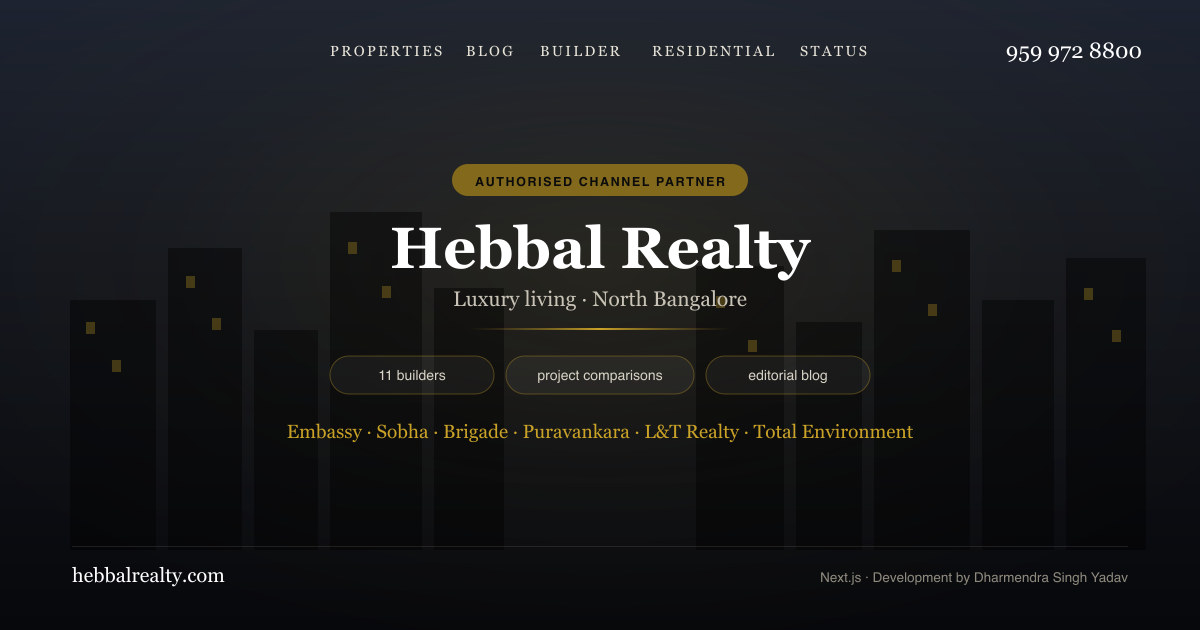
Hebbal Realty — North Bangalore Luxury Property Portal
Next.js property portal for the Hebbal luxury corridor — eleven builder pages, faceted browse, and an editorial layer of head-to-head project comparisons aimed at buyers who already have a shortlist.

Chikkajala Realty — North Bangalore Property Portal
Next.js property portal for the Chikkajala–Devanahalli airport corridor — faceted browse by builder, type and status, keyword-first project URLs, and Product/Offer schema describing real inventory.