Hebbal Realty — North Bangalore Luxury Property Portal
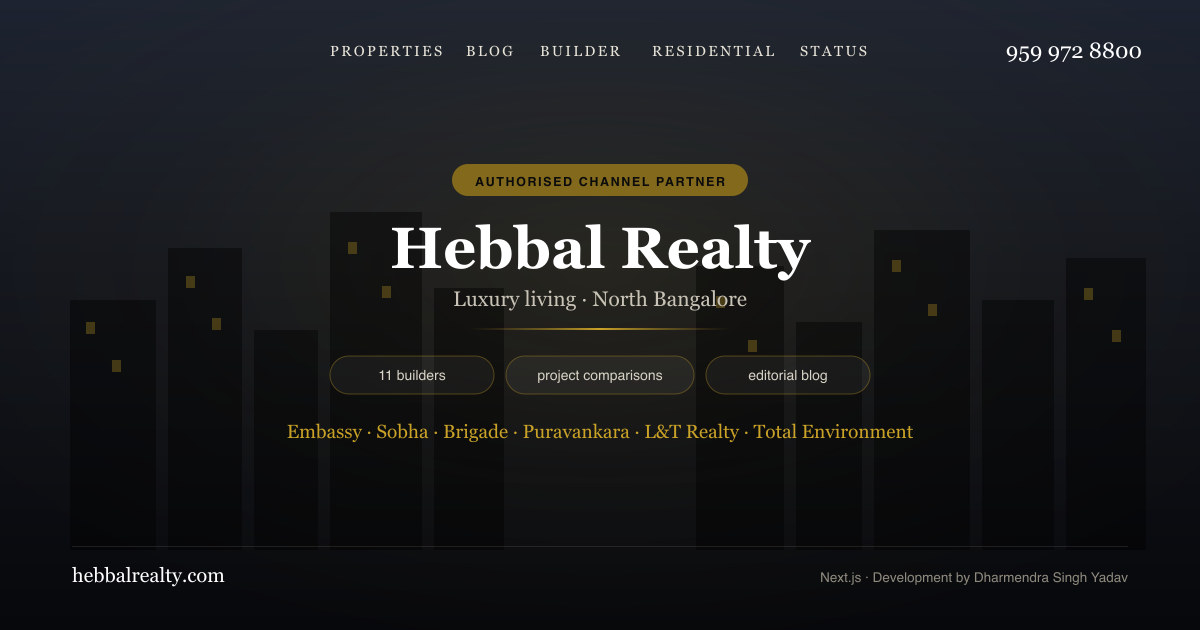
Next.js property portal for the Hebbal luxury corridor — eleven builder pages, faceted browse, and an editorial layer of head-to-head project comparisons aimed at buyers who already have a shortlist.
About this project
Hebbal Realty is a property portal for the Hebbal micro-market in North Bangalore, where Bellary Road, the Outer Ring Road and the airport corridor converge. I worked on the website as a full-stack developer. It runs the same platform as Chikkajala Realty, and the interesting part of this build was deciding what a second instance is allowed to share. The answer is: the machinery, not the argument. Faceted browse by builder, property type and status, the project detail template, the keyword-first URLs and the Product and Offer schema are all common infrastructure. What cannot be shared is what each site actually claims, because the two markets sit at opposite ends of the same investment story. Chikkajala is a frontier position — an emerging airport-corridor belt where the pitch is early entry. Hebbal is the opposite: an established, supply-constrained luxury corridor already in its appreciation phase, aimed at high-net-worth buyers rather than early investors, and the site argues that explicitly with market figures rather than adjectives. That distinction is not a copywriting nicety, it is what keeps two sister sites legitimate. Two portals running one template with the locality name swapped are doorway sites that compete with each other and dilute both domains. Two portals making genuinely different arguments to genuinely different buyers are two businesses. The build supports the second by keeping the content layer entirely separate from the template layer, so nothing structural pressures the copy toward sameness. Hebbal also carries an editorial layer Chikkajala does not: head-to-head comparison articles between named projects — Embassy One North Tower against Century Immencity, against L&T Thanisandra, against White Lotus Amanvana. "Project A vs Project B" is the highest-intent query in property search, because nobody types it until they have a shortlist and are choosing. It is also the hardest content to write honestly, since the useful version has to concede that one project genuinely wins on some axis. One of the posts reframes the comparison for a landlord rather than a resident, which changes the answer — and that is exactly the kind of piece that earns a shortlisted buyer's trust. The eleven builder pages, one more than Chikkajala, exist for the same reason the facets are pages at all: a developer with a real presence in this corridor is something to write about.
Tech Stack
Frequently Asked Questions
Details
Questions about this project?
Tell me what you're building — I'll reply within 24 hours.
Related work
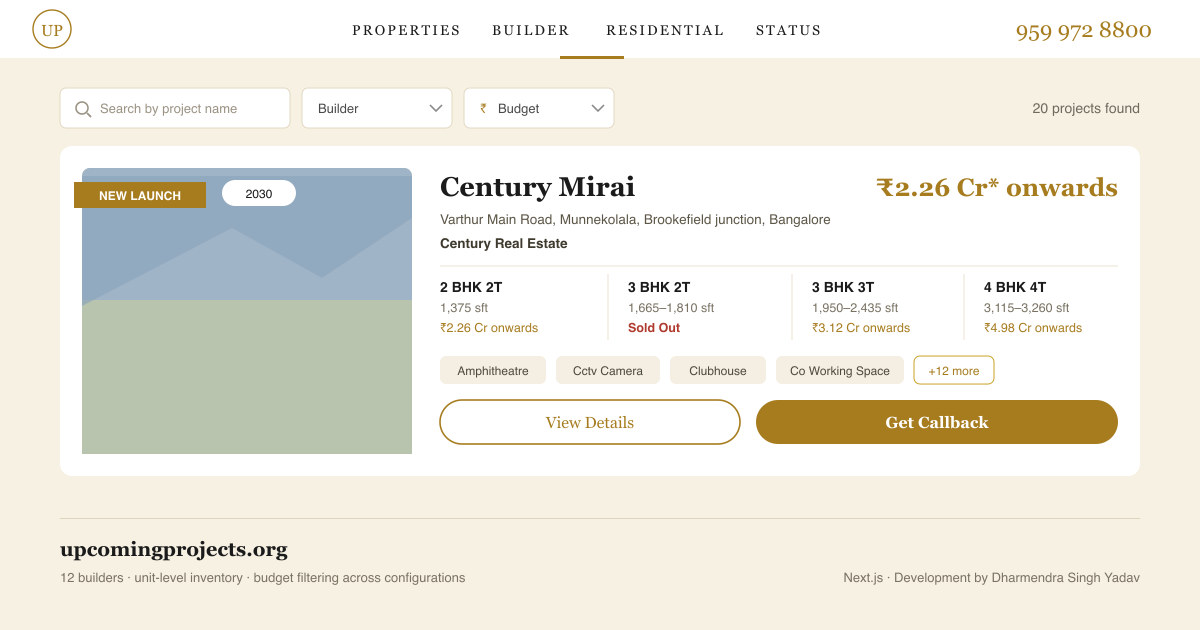
Upcoming Projects — Bangalore Property Listing Platform
Next.js listing platform for pre-launch and under-construction Bangalore developments — unit-level inventory with per-configuration pricing and availability, and budget filtering that reasons across configurations rather than projects.

LuxPropServ — Luxury Property Services Platform
Next.js site for a curated luxury property advisory — a single search across property, location, city and builder, and a schema model that describes a consultative service rather than a listings catalogue.

Saturn Realcon — Luxury Real Estate Services Website
WordPress build for a luxury real-estate services company across four cities — Elementor Pro templates over a JetEngine content model, JetSearch property search, and a handover the client's own team could operate.
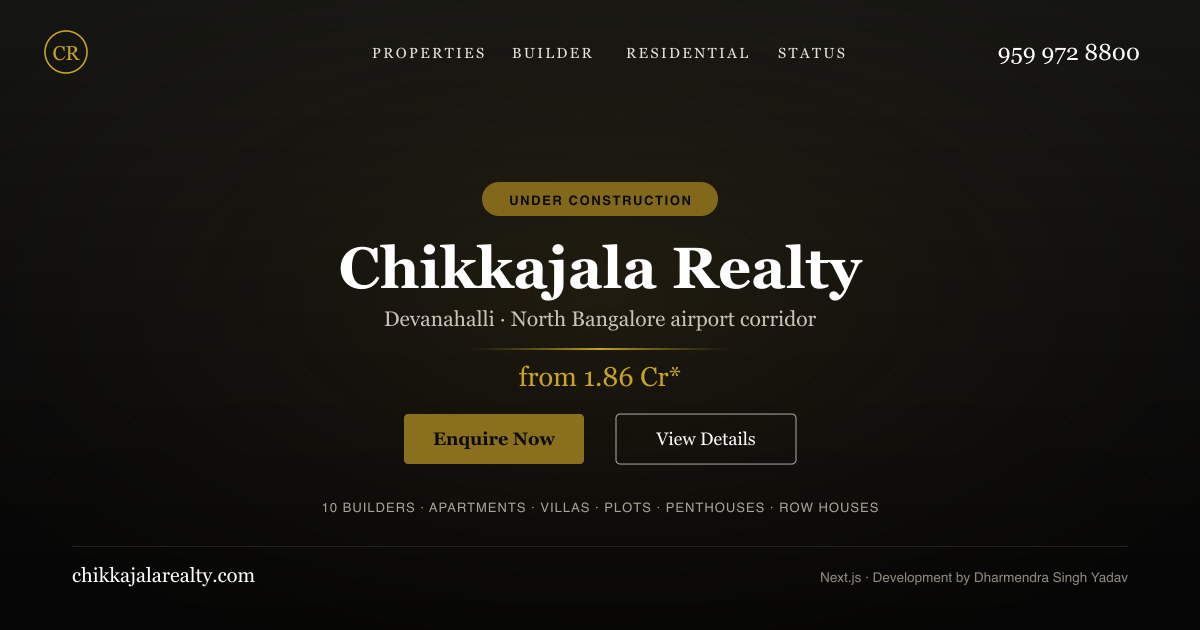
Chikkajala Realty — North Bangalore Property Portal
Next.js property portal for the Chikkajala–Devanahalli airport corridor — faceted browse by builder, type and status, keyword-first project URLs, and Product/Offer schema describing real inventory.