Project

Chikkajala Realty — North Bangalore Property Portal

Next.js property portal for the Chikkajala–Devanahalli airport corridor — faceted browse by builder, type and status, keyword-first project URLs, and Product/Offer schema describing real inventory.
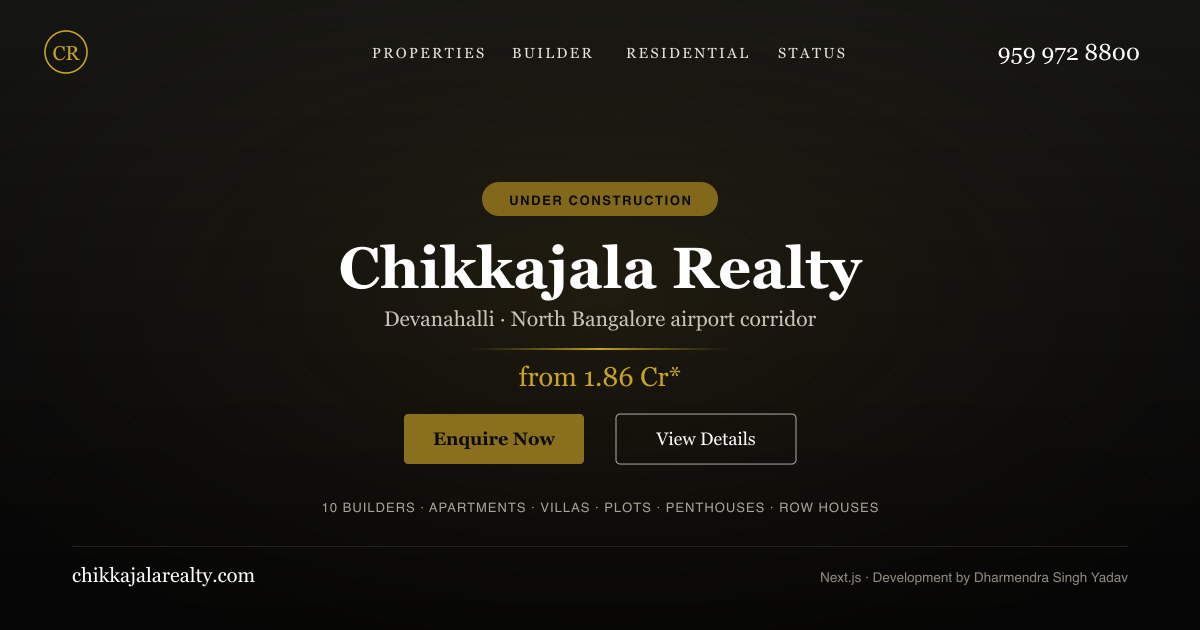
Chikkajala Realty homepage — a North Bangalore airport-corridor property portal listing projects by builder, type and construction status
Cover image for the Chikkajala Realty case study.

About this project

Chikkajala Realty is a property portal for a single micro-market: the Chikkajala and Devanahalli stretch of NH-44 in North Bangalore, inside the Kempegowda International Airport catchment. I worked on the website as a full-stack developer. Most of the real-estate work in this portfolio is single-project microsites — one development, one page, one enquiry form. This is a different problem. A portal has to let someone arrive with a vague intention and leave with a shortlist, which means the browse layer is the product. Listings are navigable three ways: by builder (Brigade, Sobha, Embassy, Lodha, L&T Realty, Sattva, Total Environment, TVS Emerald, Century, Maia Estates), by property type (apartments, villas, plots, penthouses, row houses), and by construction status. The decision I would defend hardest is that each of those facets is a real page rather than a filter state in a query string. A builder page can carry an argument about that builder in this corridor; a URL like ?builder=sobha carries nothing, cannot be linked to, and cannot rank. The cost is that every facet has to justify its existence with content — a page that only lists three cards is thin, and thin pages drag a domain down rather than extending it. Project URLs are flat and keyword-first — /total-environment-tangled-up-in-green-devanahalli-bangalore/ rather than nesting under /projects/. Buyers search "project name + locality", so the slug matches the query rather than an internal content hierarchy, and the locality suffix disambiguates developments that reuse names across cities. The schema layer does real work here. The site emits RealEstateAgent, Organization, Product and Offer per listing, OfferCatalog across them, plus BreadcrumbList and a WebSite SearchAction. Property is one of the few categories where Product and Offer map cleanly onto the thing being sold — a name, a price, a location, an availability status — so the structured data describes actual inventory rather than restating the page title. That is what makes a listing eligible to be surfaced by an assistant answering "what is available near Bangalore airport under 2 crore".

Tech Stack

Next.jsReactTailwind CSSNode.jsCloudflareJSON-LD Structured DataResponsive Design

Frequently Asked Questions

Chikkajala Realty is a property portal covering the Chikkajala and Devanahalli stretch of North Bangalore along NH-44, inside the Kempegowda International Airport catchment. It lists residential projects from developers including Brigade, Sobha, Embassy, Lodha, L&T Realty, Sattva, Total Environment, TVS Emerald, Century Real Estate and Maia Estates. The site is at chikkajalarealty.com.
I worked on the website as a full-stack developer — the Next.js front end, the listing and browse architecture across builder, property type and status, the project detail template, the enquiry capture flow, and the structured data each page type emits.
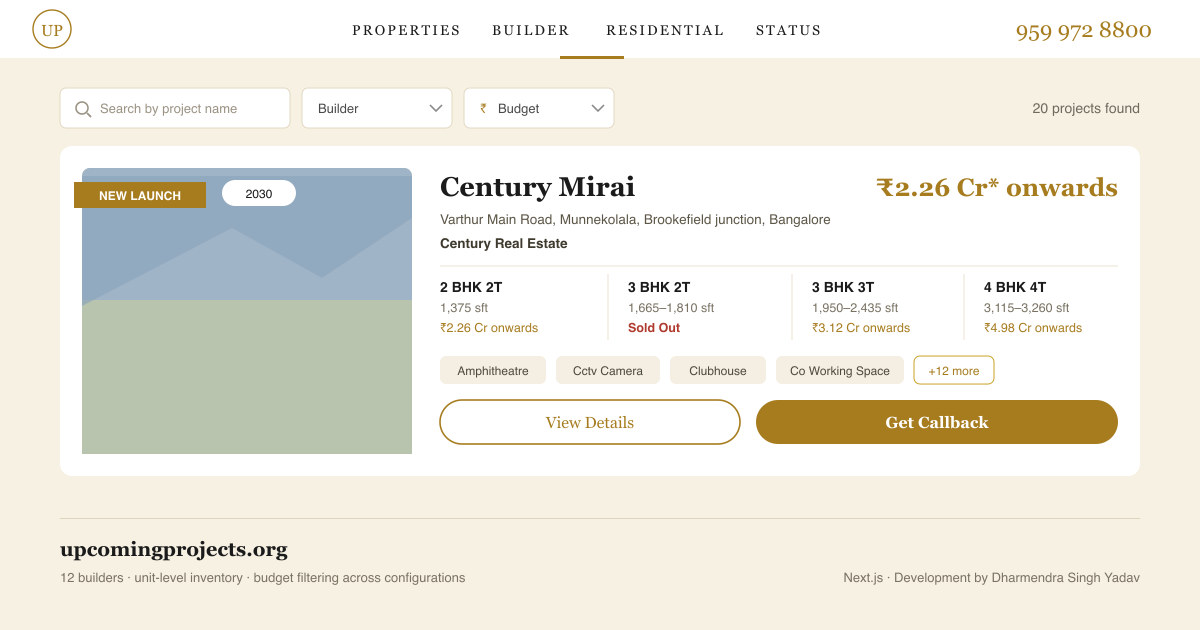
Upcoming Projects runs on the same platform but covers Bangalore as a whole rather than one corridor, and models inventory a level deeper — individual unit configurations with their own area, price and availability, rather than stopping at the project. Chikkajala is narrow and argumentative about one emerging belt; that site is broad and built around comparing what is actually purchasable.
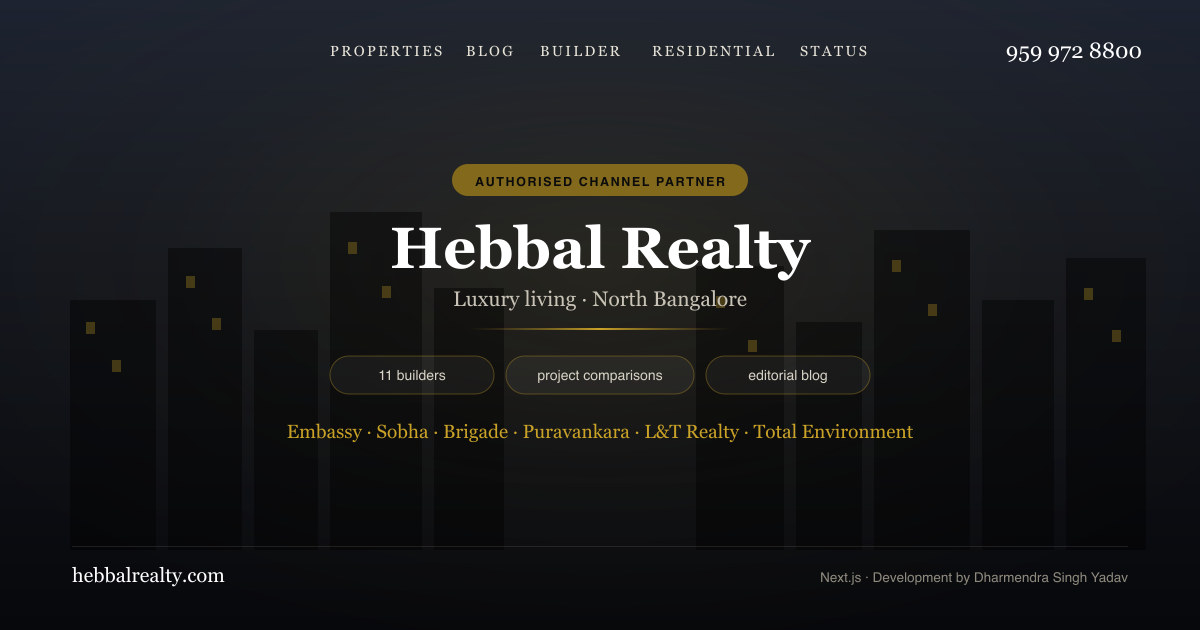
Same platform, different market and different argument. Both are North Bangalore portals I worked on, sharing the browse architecture, detail template, URL strategy and schema approach. What they do not share is the thesis: Chikkajala is an emerging airport-corridor belt sold on early entry, while Hebbal is an established, supply-constrained luxury corridor already in its appreciation phase. Two portals running one template with the locality swapped would be doorway sites competing with each other; two portals making genuinely different arguments to different buyers are two businesses.
Next.js with React, served behind Cloudflare. Listing and detail pages are statically generated with incremental regeneration so they load fast while remaining editable as inventory changes, and every page type emits JSON-LD.
A microsite sells one development: one page, one enquiry form, and the whole job is conversion. A portal has to let someone arrive undecided and leave with a shortlist, so the browse layer is the product rather than a navigation detail. That means faceted listing pages, a consistent detail template that works for any project, and an information architecture that holds up as inventory changes — none of which a single-project microsite needs.
Because a filter state cannot rank or be linked to. A page for a builder in this corridor can carry a real argument about that developer's projects there; ?builder=sobha carries nothing and is invisible to search. The trade is that every facet page then has to justify itself with content — one that lists three cards and says nothing is thin, and thin pages drag the whole domain down. Facets are worth making into pages only where there is something specific to say.
Because buyers search for the project name plus the locality, not for a content hierarchy. A slug like /total-environment-tangled-up-in-green-devanahalli-bangalore/ matches the query directly, and the locality suffix disambiguates developments that reuse the same name in different cities — which is common in Indian real estate.
RealEstateAgent and Organization for the business, Product and Offer for each listing, OfferCatalog across them, plus BreadcrumbList and a WebSite SearchAction. Property is one of the few categories where Product and Offer map cleanly onto what is actually being sold — a name, a price, a location, an availability status. That means the structured data describes real inventory rather than restating the page title, which is what makes a listing eligible to be surfaced by an assistant answering a question like “what is available near Bangalore airport under 2 crore”.
Every project page carries an enquiry form alongside WhatsApp and phone, because in this market a large share of buyers will not fill in a form but will happily message. Enquiries are captured with the project they came from attached — a lead that does not say which listing produced it is far less useful to a sales team than one that does.
Yes, and it is the main ongoing cost of a portal. Prices marked with an asterisk and statuses like under-construction go stale, and a stale price is worse than no price because it damages trust at exactly the moment a buyer is deciding. The build separates the listing data from the templates so inventory can be updated without touching code, which is the difference between a site that ages well and one that is quietly wrong within six months.
Yes. The build itself is well understood; what needs deciding up front is the taxonomy — which facets deserve their own pages, what a detail page must show, and how inventory gets updated once the site is live. Get that wrong and you either end up with hundreds of thin pages or a site nobody can maintain. Use the form on this page and tell me the market and roughly how many listings, and I will give you an honest read on scope.

Details

Organization
Chikkajala Realty
Role
Full-Stack Developer
Timeline
Client engagement

Questions about this project?

Tell me what you're building — I'll reply within 24 hours.