Saturn Realcon — Luxury Real Estate Services Website
WordPress build for a luxury real-estate services company across four cities — Elementor Pro templates over a JetEngine content model, JetSearch property search, and a handover the client's own team could operate.

About this project
Saturn Realcon is a luxury real-estate services company operating across Gurgaon, Delhi, Bangalore and Kasauli. I worked on the website as a full-stack developer. It is the only build in this portfolio that is not JavaScript, and that was the decision worth defending. Everything else here is Next.js; this one is WordPress with Elementor Pro on the Hello Elementor theme, with JetEngine driving the property post types and JetSearch powering the search. The reason is not budget or speed of delivery — it is who owns the site afterwards. A marketing team that publishes several times a week and edits city and service pages without asking a developer is better served by a page builder they can actually use than by a codebase where every copy change is a pull request. Choosing the boring tool because the handover matters more than the stack is a judgement call, not a compromise. The site is service-led rather than listing-led, which shapes the whole architecture. The proposition is end-to-end — research-based buying, home loan facilitation, rental and repair, furnishing, high-end construction and property management, sold on a zero-brokerage model. So services are the primary axis and properties support them, the reverse of a portal. Cities form the second axis, which is where JetEngine earns its place: property types are modelled as custom post types with taxonomies, and the city and category pages are dynamic listings over those, not hand-built pages that drift apart as inventory changes. The parts that needed real care were the ones a page builder does not solve for you. Elementor will happily produce a page that looks right and loads slowly, so the work was in disciplining it — controlling how many widgets a template carries, keeping image weight down on a site whose whole subject is large interior photography, and making sure the search returns something useful rather than a raw keyword match. A visual builder removes the barrier to building pages; it does not remove the responsibility for what those pages cost to load. Alongside the nine core pages there is an editorial layer of around thirty posts, which is what a service business in this market actually competes on.
Tech Stack
Frequently Asked Questions
Details
Questions about this project?
Tell me what you're building — I'll reply within 24 hours.
Related work
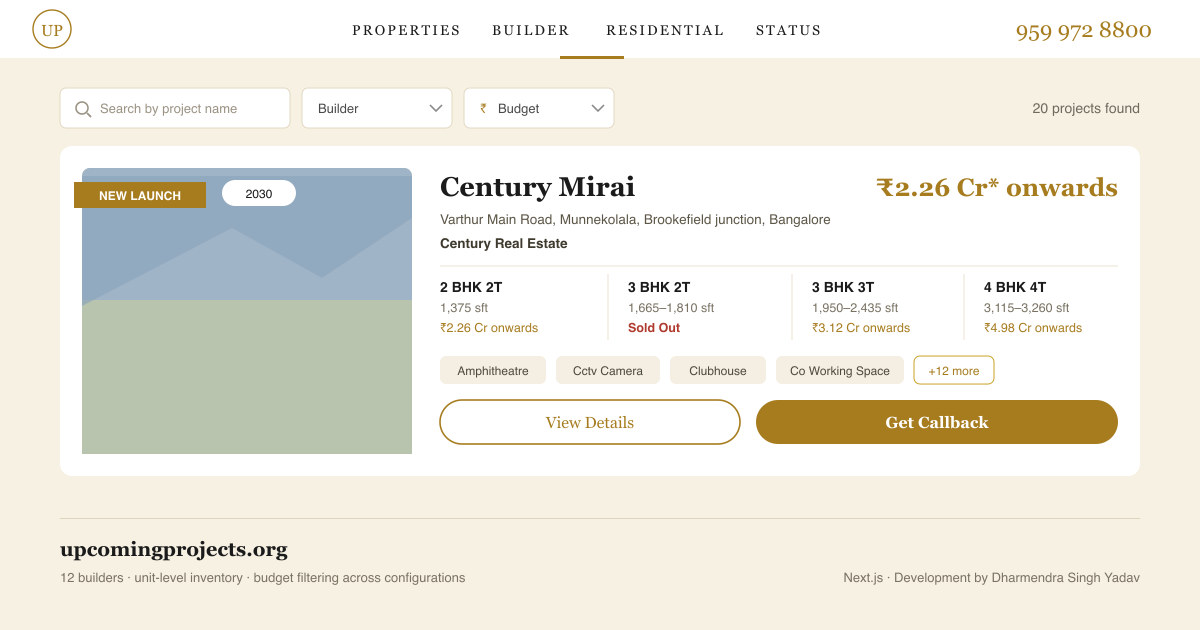
Upcoming Projects — Bangalore Property Listing Platform
Next.js listing platform for pre-launch and under-construction Bangalore developments — unit-level inventory with per-configuration pricing and availability, and budget filtering that reasons across configurations rather than projects.

LuxPropServ — Luxury Property Services Platform
Next.js site for a curated luxury property advisory — a single search across property, location, city and builder, and a schema model that describes a consultative service rather than a listings catalogue.
Hebbal Realty — North Bangalore Luxury Property Portal
Next.js property portal for the Hebbal luxury corridor — eleven builder pages, faceted browse, and an editorial layer of head-to-head project comparisons aimed at buyers who already have a shortlist.
Chikkajala Realty — North Bangalore Property Portal
Next.js property portal for the Chikkajala–Devanahalli airport corridor — faceted browse by builder, type and status, keyword-first project URLs, and Product/Offer schema describing real inventory.