Project

Codeaxes — Full-Cycle IT Solutions Website

Scroll-driven marketing site for a full-cycle IT solutions company — nine service lines across seventeen industries, built with GSAP, ScrollTrigger and Locomotive Scroll on static HTML rather than a framework.
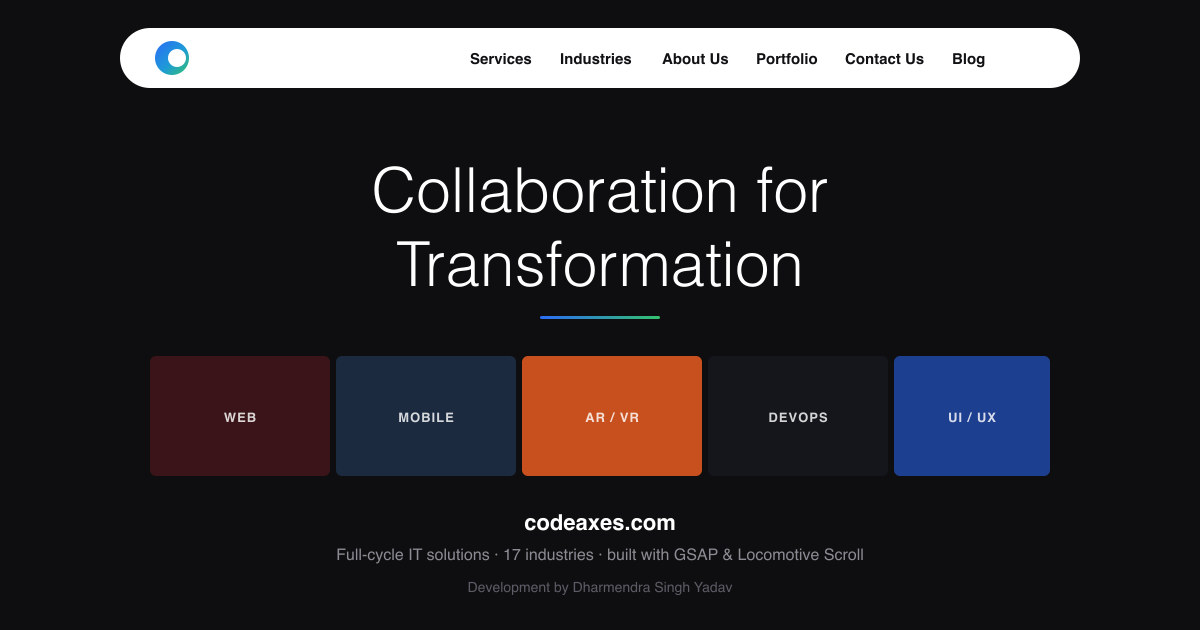
Codeaxes website homepage — a full-cycle IT solutions company site with a scroll-animated showreel, built by Dharmendra Singh Yadav
Cover image for the Codeaxes case study.

About this project

Codeaxes is a full-cycle IT solutions company, and codeaxes.com is its primary sales asset. The brief that shapes everything on it is harder than it looks: the company sells nine service lines across seventeen industries, and a visitor has to be able to find the one thing they came for without reading any of the other twenty-five. The answer was a taxonomy rather than a longer homepage. Services split into web, mobile, AR/VR, digital marketing, DevOps, UI/UX, dedicated teams and product strategy; industries run from healthcare and fintech to media and OTT, logistics, government and on-demand. Both dimensions are navigable from the same header, so a hospital CTO and a games studio arrive at different pages from the same menu without either being shown a generic capabilities list. The homepage carries the persuasion in a specific order — the "Collaboration for Transformation" positioning, then a showreel of delivered work, then the four-phase Discover / Design / Develop / Deliver process, then named client testimonials, then the technology matrix. That sequence is deliberate: agency buyers want proof before process, and process before stack. Technically it is a scroll-driven build rather than a framework SPA — GSAP with ScrollTrigger for the sequenced reveals and Locomotive Scroll for the smooth-scroll behaviour, served as static HTML behind nginx. That was the right trade for this site. A marketing page whose main job is to load fast and animate smoothly on a first visit does not benefit from shipping a hydration bundle, and the scroll choreography the design depends on is far easier to control directly than through a component lifecycle. The interesting engineering problem was not the animation, it was making it survive contact with reality: scroll-linked animation is the fastest way to build a page that stutters on a mid-range Android or breaks entirely when a section's height changes. Pinned sections have to be measured after images resolve, ScrollTrigger has to be refreshed rather than re-instantiated, and every reveal needs a resting state that reads correctly if the animation never fires at all — because for a share of real visitors it will not.

Tech Stack

HTML5CSS3JavaScriptGSAPScrollTriggerLocomotive ScrollResponsive Designnginx

Frequently Asked Questions

Codeaxes is a full-cycle IT solutions company that builds software for businesses across roughly seventeen industries — healthcare, education, media and OTT, travel, retail, real estate, games, marketplaces, fintech, insurance, government, logistics and more. Its service lines span web development, mobile, AR/VR, DevOps, UI/UX, digital marketing, dedicated teams and product strategy. The site is at codeaxes.com.
I worked on the development of the site — the front-end build, the scroll-driven animation layer, and the page architecture that carries nine service lines and seventeen industry verticals without collapsing into one generic capabilities page. Codeaxes is a client, not a product of mine; Gautam from their team is one of the testimonials on this portfolio.
It is a static, scroll-driven build rather than a JavaScript framework application: hand-written HTML and CSS with GSAP and ScrollTrigger driving the sequenced reveals, Locomotive Scroll for the smooth-scroll behaviour, and nginx serving it. Deliberate for a marketing site whose main job is to load fast on a first visit — there is no benefit to shipping a hydration bundle for a page with no application state.
Because nothing on the page needed it. There is no authentication, no user state and no data that changes per visitor — it is content plus choreography. Adding a framework would have added a bundle to download and parse before the first animation could run, which works directly against the one metric that matters here. I use Next.js constantly where it earns its place; this was not one of those cases, and choosing the smaller tool is part of the job.
Three habits. Every animated element gets a resting state that reads correctly if the animation never fires, because for some visitors it will not. Pinned sections are measured after images resolve rather than on DOMContentLoaded, so a late-loading hero cannot shift every trigger point below it. And ScrollTrigger gets refreshed on resize and on content height changes rather than re-instantiated, which is the usual cause of a page that works on load and then drifts out of sync.
It can, and that is the real risk with any scroll-linked build. The mitigations are transform-and-opacity-only animation so the compositor does the work rather than the layout engine, no scroll handlers doing layout reads, and honouring prefers-reduced-motion so anyone who has asked their device to stop moving things gets a static page. Scroll choreography that only works on a flagship is a design that has not been finished.
By making each page argue something specific to that industry rather than find-and-replacing the sector name. A healthcare page that talks about compliance and record systems and a games page that talks about latency and retention are genuinely different pages; the same page with one noun swapped is a doorway page, and search engines treat it accordingly. Where there is nothing specific to say, the honest answer is fewer pages.
No — they are unrelated companies that happen to both appear in this portfolio. Codeaxes is a full-cycle IT solutions company; Dharmsy Innovations is a registered product studio. Different clients, different briefs, different builds. The entries are written to keep that distinction clear rather than blur it.
Their portfolio is on codeaxes.com and includes projects such as a customisable wristband platform, a banquet-hall presence, and an immersive web AR experience tied to Amazon Prime Video's Farzi. Those are Codeaxes' client projects rather than mine, and I list them here only as context for what the site had to present.
Yes — a multi-service, multi-industry site with real animation is a well-defined piece of work and one I have shipped. The part worth budgeting for is not the animation, it is the information architecture: deciding what each page argues before anyone writes markup. Use the form on this page and tell me how many services and sectors you sell into, and I will give you an honest read on scope and cost.

Details

Organization
Codeaxes
Role
Full-Stack Developer
Timeline
Client engagement

Questions about this project?

Tell me what you're building — I'll reply within 24 hours.