
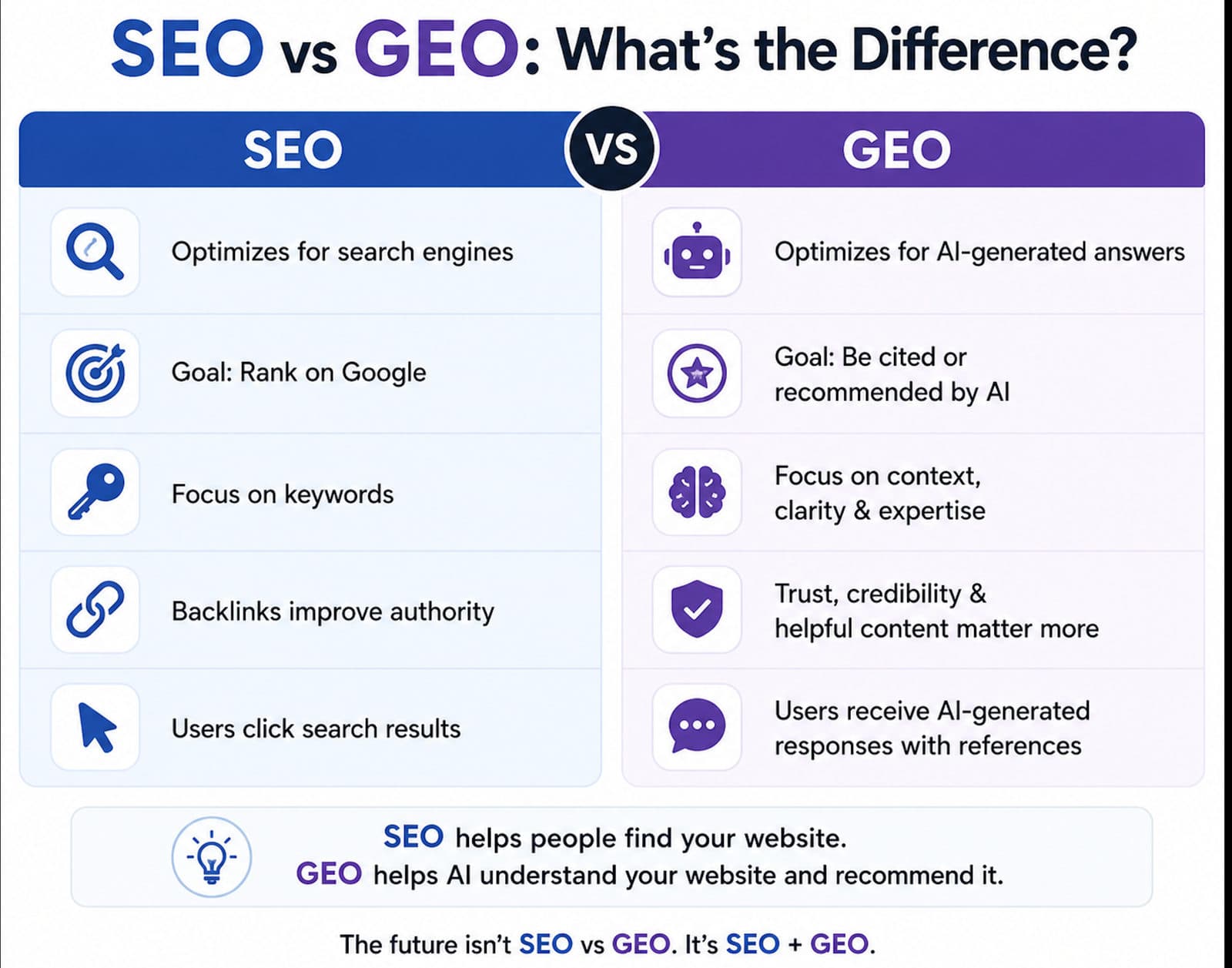
In 2026 you don't have one search problem. You have two. The first is the one every marketing team has fought for twenty years: rank on Google. The second is newer, weirder, and quietly reshaping how the internet finds information: get cited by the AI answer engines that now sit between users and the web — ChatGPT, Perplexity, Claude, Gemini, Google's AI Overviews, Bing Copilot.
The old discipline is SEO — Search Engine Optimization. The new one is GEO — Generative Engine Optimization. They sound similar, they overlap in places, and marketing agencies now sell both. But they are fundamentally different games, played against different systems, measured by different signals, and won with different content.
This post is a long, honest breakdown of exactly how SEO and GEO differ, why GEO stopped being optional in 2025, and what actually changes about your content strategy when you take both seriously. If you run a business website, an agency, a personal brand, or a SaaS product, this is the shift you don't want to be late for.
1. SEO in One Sentence
SEO is the practice of getting your web page to rank high on a search engine results page (SERP) so that users click through to your site. Everything else in SEO is a subgoal of that one outcome: rank higher → get clicked → get traffic.
The mechanical loop looks like this:
- A crawler (Googlebot, Bingbot) fetches your page.
- The engine indexes its content, tags, structure, and links.
- When someone searches, the ranker scores your page against thousands of others using ~200 signals — content relevance, backlinks, page speed, Core Web Vitals, freshness, entity clarity, user engagement, HTTPS, mobile-friendliness, and so on.
- The top 10 results are shown as a list of blue links.
- Your reward is a click.
Twenty years of SEO strategy — keyword research, on-page optimization, link building, schema markup, technical audits, content clusters, EEAT signals — all reduce to that one mechanical loop. You optimize for the crawler and for the ranker, then you fight for the click.
2. GEO in One Sentence
GEO is the practice of shaping your content so that generative AI engines cite you, quote you, and reproduce your language when they synthesize an answer for a user.
Notice what's different: the reward is not a click. The reward is a citation inside a machine-generated answer, delivered directly to the user by an LLM — often without the user ever visiting your site.
The mechanical loop looks like this:
- A user asks an AI answer engine a question in natural language.
- The engine reformulates the query, does one or more retrievals (its own search index, live web fetch, or a hybrid), and pulls in the most relevant chunks of content it can find.
- An LLM reads those chunks and synthesizes a single answer, blending language and facts from multiple sources.
- The engine cites its sources — sometimes as inline links, sometimes as a small "sources" panel, sometimes not at all.
- Your reward is being named in that answer, and (occasionally) a visitor clicking a source link.
GEO is not "SEO for ChatGPT." It's a fundamentally different game where the winning move is being extractable, quotable, and trustworthy at the paragraph level — not just at the page level.
3. Why GEO Exploded Between 2024 and 2026
Two numbers explain everything.
- In May 2024, Google rolled out AI Overviews to all US users. By early 2026, roughly 60% of Google searches result in an AI-generated answer at the top — often eliminating the need for the user to click any blue link at all.
- ChatGPT, Perplexity, Claude and Gemini collectively handle an estimated 1.4 billion "search-intent" queries per day as of Q1 2026 — up from ~200 million in early 2024. That traffic no longer touches Google's SERP at all.
Translation: a huge fraction of the queries your business used to compete for on Google are now being answered by an LLM before the user ever sees your page. If your content isn't shaped to be cited by those LLMs, you've been erased from that portion of the discovery funnel — and no amount of traditional SEO can recover it.
This is the reason GEO went from a niche buzzword to a core marketing discipline in under 24 months. It's not hype. It's an infrastructure change.
4. Side-by-Side: How SEO and GEO Actually Differ
| Dimension | SEO (Search Engine Optimization) | GEO (Generative Engine Optimization) |
|---|---|---|
| Target system | Google, Bing, DuckDuckGo | ChatGPT, Perplexity, Claude, Gemini, Google AI Overviews, Bing Copilot |
| Reward | A click from the SERP | A citation inside a generated answer |
| Primary unit of optimization | The page | The paragraph / chunk |
| What the algorithm reads | Full HTML, metadata, backlinks, structured data, user signals | Retrieved text chunks, embedded semantics, source authority |
| Winning content style | Long, keyword-rich, clustered around topics | Direct, self-contained answers with clear entities and citations |
| Link value | Backlinks are still gold | Being cited or quoted by other authoritative sources matters more than raw link count |
| Freshness | Important for news / trending topics | Very important — LLMs often prefer recent content in retrieval |
| Measurement | Search Console rankings, clicks, CTR, impressions | Citation share across AI engines (share-of-voice), brand mentions, referral traffic from LLMs |
| Failure mode | Rank drops → traffic drops | You're never cited → you slowly disappear from AI-mediated discovery |
5. What Actually Wins in GEO
The single biggest mindset shift in GEO is this: LLMs don't rank documents, they synthesize answers. When your paragraph is well-written, clearly attributed, factually specific, and easy to extract, an LLM will lift language directly from it into its answer. When your paragraph is fluff, hedged marketing copy, or generic listicle content, the LLM skips over you in favour of a source that reads more authoritatively.
Concretely, GEO-winning content tends to have all of these:
- Self-contained paragraphs. Each paragraph should read like a standalone answer to a specific question. LLMs retrieve chunks, not entire pages — a paragraph that only makes sense in the context of the six paragraphs before it will get skipped.
- Direct declarative statements. "Page speed is a Google ranking factor." not "Some experts argue that page speed may, in some cases, influence rankings." LLMs prefer clear factual claims they can quote.
- Named entities. Products, people, technologies, standards, dates. "Google's Core Web Vitals — LCP, INP, and CLS — became the primary page-experience ranking signals in March 2024" beats "the new speed metrics."
- Explicit numbers and dates. LLMs weight specifics heavily. "600ms server response" outranks "slow server."
- Source-worthy structure. Clear H2/H3 hierarchy, tables, ordered lists, definition lists. Retrieval systems love structure.
- Author identity + expertise signals. Bylines with credentials, "About the author" boxes, links to LinkedIn or ORCID. This is EEAT for LLMs.
- Fresh dates. "Last updated: October 2026" gives retrievers a strong recency signal.
- Uniqueness of claims. If your paragraph is the only place a specific stat, method, or definition appears, LLMs will quote you rather than someone else.
6. Where SEO and GEO Reinforce Each Other
The good news is they aren't opposing games. In fact most GEO wins are also SEO wins — the two systems are increasingly converging on the same signals of quality, structure and authority.
Practically, you get double the leverage from:
- Structured data (JSON-LD). Google uses it for rich results; LLMs use it as a machine-readable summary of your content's entities and relationships.
- Clear H2/H3 headings that literally are the questions your audience asks. This wins featured snippets on Google AND makes your content easy for LLMs to retrieve.
- FAQ sections. A well-marked-up FAQPage schema gets you the FAQ rich result on Google and gets you cited by ChatGPT / Perplexity when users ask those exact questions.
- Fast pages. Google rewards Core Web Vitals; LLM crawlers timeout on slow pages and skip them entirely.
- Original data and research. First-party statistics get cited by both SERPs and LLMs — one dataset can carry a domain for years.
7. Where SEO and GEO Diverge
Some tactics that worked well for SEO will actively harm your GEO performance:
- Keyword-stuffed intros. LLMs recognize marketing filler and downrank it in retrieval. Google is more forgiving.
- Overly clever titles. "The 7 Secret Hacks Nobody Tells You About Page Speed 🔥" gets clicks on Google. LLMs treat it as low-signal noise.
- Buried answers. The classic SEO trick of making users scroll past three paragraphs of throat-clearing before answering the question — LLMs never scroll. They extract the first clean answer they find, and if that answer isn't in the first paragraph of a section, they retrieve someone else's page.
- Aggressive interlinking to keep users on-site. LLMs don't follow those links. Their world is chunks, not sessions.
- Content clusters designed for click-depth. Great for Google's topical authority signal. Neutral-to-slightly-negative for GEO if the individual pages aren't self-contained.
8. What a 2026 Content Strategy Actually Looks Like
If you're planning content for the rest of 2026 and beyond, the operating model that works is roughly:
- Answer real questions, not head-term keywords. The unit of demand is now "what someone asks their AI," not "what someone types into Google." Voice-of-customer research, Reddit mining, and support-ticket analysis matter more than keyword volume charts.
- Structure every article as a series of quotable answers. Each H2 is a question or a claim. Each first paragraph under it is a direct, self-contained answer. Then supporting detail below.
- Add a "quick answer" or TL;DR box at the top of every long article. This is what LLMs lift verbatim. Write it as if it were the whole answer.
- Ship first-party data. Original benchmarks, case studies, before/after screenshots, real numbers. These are the paragraphs that get quoted.
- Publish under identifiable authors. LLMs increasingly weight author entity as a trust signal. "Anonymous" is a dead brand strategy in 2026.
- Update aggressively. Refresh flagship posts every 3–6 months. Freshness matters more to retrievers than to SERPs now.
- Measure both — SERP rankings (SEO) and citation share (GEO). Tools like SEMrush and Ahrefs have added AI-visibility reports; smaller vendors (Peec.ai, Otterly, Profound, Athena) do it more precisely.
9. The GEO Checklist for Your Next Blog Post
Before publishing anything in 2026, run it against these ten questions:
- Is my headline a clear, direct claim or question that a user would ask?
- Does the first paragraph answer that question in a way that could stand alone as a quote?
- Do all my H2 subheadings function as retrievable sub-questions?
- Are my key claims specific — with numbers, dates, or named entities?
- Is there a "quick answer" or summary box near the top?
- Is there an FAQ section with FAQPage schema?
- Is there a clear author byline with credentials?
- Is the page fast (LCP under 2.5s, INP under 200ms)?
- Is there original data or first-party experience that no competitor has?
- Is the last-updated date visible and machine-readable?
If you can honestly answer yes to all ten, you have content that competes in both games.
10. What NOT to Do
A few tempting mistakes to avoid:
- Don't gate your best content behind "sign up to read more." LLM crawlers can't get past the gate and will simply cite the competitor who left the door open.
- Don't use AI to write the entire post. LLMs are getting better at detecting other LLMs' output, and search engines are starting to demote content that shows no first-hand experience or unique perspective. Use AI to draft; keep the voice human.
- Don't obsess about being #1 on Google if you're being cited by ChatGPT. The traffic curve is quietly shifting. Being cited by an LLM that has 500M weekly users can be worth more than being ranked #4 on a keyword with 20K monthly volume.
- Don't skip technical SEO because "GEO is the future." Fast, crawlable, well-marked-up pages are a precondition for both games. Ignore technical SEO and you'll fail at both.
- Don't chase every new AI tool. The winners in GEO right now are the same publishers who invested in clear structure, first-party data, and authorial credibility a decade ago for SEO. The underlying discipline hasn't changed — just the format.
11. The Bottom Line
SEO is not dead. It is still — in early 2026 — the single largest source of discovery on the internet. Google is not going anywhere, and the blue links are not disappearing. But SEO is no longer sufficient. A growing share of the queries your audience asks now end inside an AI answer, and if your content isn't shaped to be quoted there, you're invisible to a rapidly growing slice of the market.
The right way to think about GEO in 2026 is not as a replacement for SEO but as its dual. SEO gets you the click. GEO gets you the quote. The businesses that win the next decade will be the ones that do both — deliberately, measurably, and without treating either one as an afterthought.
The good news is you don't need a separate team or a separate content calendar. You need a slightly different lens on the same posts you were going to write anyway: write for the human who's asking the question, and write in a way that a machine can quote you when it answers them.
Do that consistently for twelve months and you'll show up in both places — the ranked list and the generated answer. In 2026 that combination is the entire ballgame.